

Choke and kill hoses
About the product
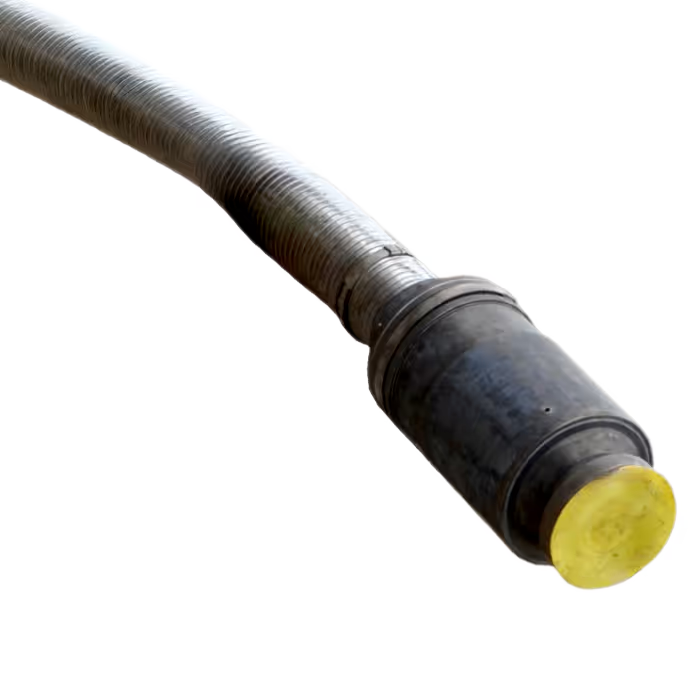
Choke and kill hoses are flexible high-pressure hoses that form part of the well control system. They are used to circulate fluid during pressure regulation, blowout control or well pressure balancing.
Deep Drill supplies hoses in standard and custom lengths, suitable for extreme pressure, temperature and chemical loads. Our hoses meet strict safety standards and are equipped with the correct couplings for connection to manifolds, chokes or BOP stacks.
Available for hire and sale, including certification and test report.
Technical specifications
- Diameter: 2" to 4"
- Lengths: standard 15–60 ft, custom lengths available
- Pressure rating: up to 15,000 PSI (working pressure)
- Inner hose: acid- and oil-resistant rubber or HNBR
- Jacket: steel wire braid or spiralled armour
- Connection: hammer union, flange or customer configuration
Quality and certification
- Hydrostatically tested, visually inspected and certified
- Supplied with serial number, batch documentation and test certificates
- Marking according to standard and colour coding
Interested?
Are you looking for safe, robust hoses for pressure regulation or blowout control? Contact us, we deliver quickly and with approval.

FAQ section.
What is a choke and kill hose used for?
These hoses are used to supply or remove fluid during pressure regulation and blowout prevention. They are a vital part of the well control system.
What types and lengths are available?
We supply hoses in various diameters and lengths, tailored to your system and required working pressure. Customisation is possible.
Are these hoses available for hire and sale?
Certainly. You can choose what suits your operation. Rental is useful if you need extra lines temporarily or for replacement during overhaul.
For which projects are these hoses suitable?
Choke and kill hoses are used in oil and gas drilling, geothermal energy and injection wells where pressure control is crucial, such as in CO2storage.
What documentation will I receive upon delivery?
You will receive test reports, batch information, product certificates and, optionally, assembly and inspection instructions.
